
The era of Human Software

If you’ve been a subscriber, you’ll notice the name change from Where Value Moves. This shift represents a shift in how I am approaching artificial intelligence.
Where Value Moves focused on the external system — how shifting constraints in the market cause the value of work to migrate.
But I’ve learned that true differentiation does not start by looking out at the market; it starts by looking in.
If you’re like most people, and your goal is to merely survive the AI tsunami, then please stick to the typical advice given by most AI experts:
😫 head-on-a-swivel, trying out every new model feature upon release
😫 constantly taking AI courses just to keep up
😫 obsessing over automating everything
You’ll do fine. Seriously.
It’s logical, safe, expected, and…boring.
On the other hand, if you want to actually innovate with AI, you have to roll up your sleeves, get down and dirty, throw elbows, go against the grain, reject popular narratives, deny groupthink, think in first principles, and step into the ring of category creation.
Now that’s exciting.
Because in an era where everyone has access to the same intelligence, “better” isn’t rewarded. Only “different” is.
That’s why I changed the name of this Substack to The Source Code.
Because creating a category-defining AI Narrative requires extracting the fundamental simplicity of “self”— your deeply held beliefs, your tacit knowledge, and your unique worldview — and mapping that onto the technology.
We may not be able to control the ocean waves of constant AI disruption, but we can encode our DNA into the LLM, build our boat, and join with others on our journey to scale intelligence (fleets).
The False Promise of Automation
To understand why surviving AI disruption is not enough, let’s first look at the assumptions people commonly make about AI.
The dominant narrative across the corporate world is that AI is for efficiency and automation.
The assumption is that by bolting AI onto our existing workflows, we will “amplify” ourselves, save time, and finally free ourselves from the drudgery of modern work.
But reality tells a different story:
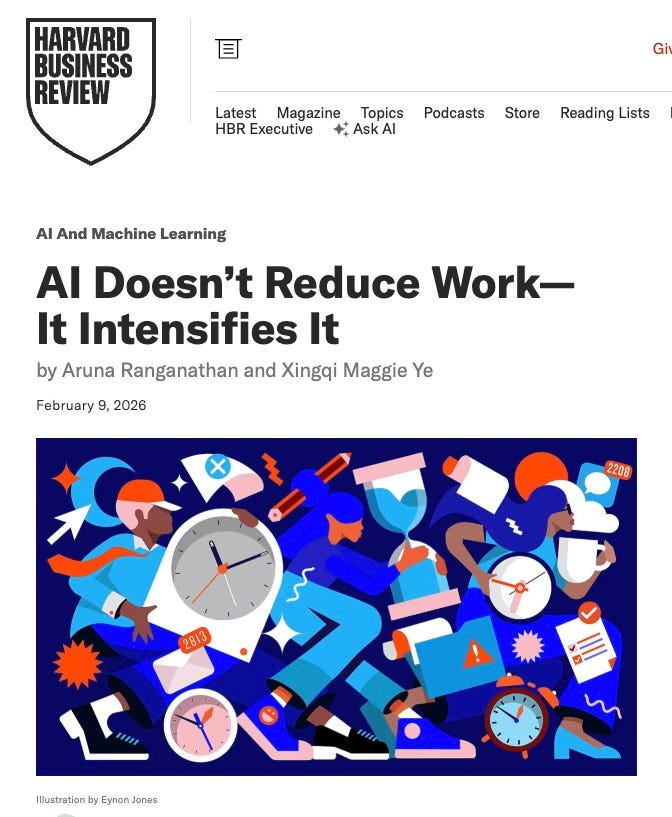
A recent study published by the Harvard Business Review observed a 200-person tech company over eight months to see how Gen AI actually changed work habits.
The paper revealed a self-reinforcing cycle of workload growth that directly contradicts the promise of automation.
Instead of working less, employees experienced severe “task expansion”.
Because AI made starting a new task incredibly easy, workers spontaneously absorbed responsibilities that traditionally belonged to other departments — designers began writing code, while product managers took on engineering tasks.
The low-friction prompting of AI blurred the boundaries between work and downtime.
Employees found themselves prompting the AI during lunch breaks, in transit, and late at night, turning their jobs into an “ambient” presence that never fully stopped.
This created a paradox: workers felt more productive, yet simultaneously busier (closer to burnout).
When speed becomes the only metric, we fall into a trap where AI simply accelerates the “old thing,” leading to exhaustion, not innovation.
Redefining Value in Shifting Systems
This exhaustion occurs because we are trying to solve a systemic shift with a task-level mindset.
Work is not simply a bundle of tasks; it is a response to constraints within a larger economic system.
When a new technology like AI enters the ecosystem, it completely alters the economic logic of that system.
Historically, the execution of skilled knowledge—like writing code, drafting strategy, analyzing data—was scarce and expensive.
AI makes the execution of these tasks now abundant and cheap.
When answers become a commodity, the market stops rewarding the people who simply produce answers faster.
The value rapidly migrates to the ability to manage risk, exercise judgment, and to coordinate fragmented systems.
If you are mostly using AI to speed, up your old deliverables, your pricing power will collapse.
To maintain your premium, you must stop competing on raw execution and start competing on how you see the world.
The Anatomy of Tacit Knowledge
If execution is no longer the scarce resource, what is the fundamental building block of your value?
Enter your “Human Software”.
Human Software is your tacit knowledge. It is the deeply ingrained judgment, the contrarian opinions, instinctual pattern recognition, and the non-negotiable standards you have developed over decades of lived experience. This knowledge is jagged, nuanced, and inherently human.
By contrast, AI out of the box is smooth and cautious because it is trained on the aggregate data of the entire internet.
If you use AI without installing your tacit knowledge into it, your output will sound like the generic middle of the marketplace.
Architecting Your Human Software OS

To leverage this, you must extract your tacit knowledge and codify it into a formal operating system. Human Software OS consists of three foundational layers that allow you to scale your genius without losing your edge:
The Worldview Layer (Value Creation): This is the “Source Code” of your philosophy. It defines the exact market conflict only you can solve, names the specific villain in your customer’s world, and plants a contrarian flag in the ground. It is your manifesto.
The Commercial Framework (Value Capture): This layer transforms your worldview into a tradeable asset. You formalize your consulting or leadership process into a named, diagnostic methodology with clear steps, allowing you to stop selling hours and start selling a defensible system.
The AI Framework (Value Scaling): This is the bridge between your brain and the machine. You build custom instructions and narrative guardrails that allow the AI to reason using your Worldview and Commercial Framework.
When you install this OS, the AI stops being hit-and-miss and becomes a cognitive partner that actively applies your specific taste, judgment, and worldview to everything you do with AI.
The Inside-Out Approach to Category Creation
Once your Source Code is extracted, you can use it to define an entirely new market category.
This requires abandoning the traditional “Outside-In” approach, where leaders look at market trends and try to bolt technology onto their brand.
Category creators use an “Inside-Out” approach. They start with the internal discovery of purpose and values, and then they map those human elements directly onto the technology.
This echoes Steve Jobs’ famous principle that technology alone is not enough; it is technology married with the humanities that yields category-defining results.
Naming the New Reality
We can see this Inside-Out approach executed by today’s visionary leaders. They do not parrot industry definitions of AI. They extract their brand’s Source Code and use it to frame the technology around their narrative and worldview.
When Bob Iger looks at AI for Disney, he maps it to Disney’s magical moments. He defines AI not as a productivity tool, but as an “experience layer”.
When Jensen Huang looks at data centers, he maps NVIDIA’s industrial worldview onto them, creating the category of “AI factories.”
When Tim Cook positions Apple Intelligence, he anchors it to Apple’s Source Code of privacy and individuality, calling it “personal intelligence”.
These are not just clever marketing slogans. They are deep, operational metaphors that dictate how these companies hire, allocate resources, and measure success.
They name the category, aim it at their core thesis, and install it into their culture.
The Endurance of Eternal Skills
As we rely more heavily on AI to execute tasks, technical skills such as prompt engineering will eventually be automated by the machines themselves.
The big question becomes: What remains when the technical complexities are stripped away?
The answers are found in our eternal human fundamentals:
Prompting = clear communications reframed for a machine.
Building autonomous agents = capacity for delegation and trust.
Curating data = taste and judgment.
By viewing AI through the lens of your Source Code, you keep your humanity at the center of the technological shift.
Building Your Own Boat

The AI revolution is not about adopting the latest software. It’s an invitation to decode the deepest parts of professional identity and project them into the world.
If you try to out-automate your competitors, you will simply drown in the ocean of commoditization.
AI has driven the cost of execution and mechanics to near zero. When “how to do it” becomes fast, cheap, and automated, buyers stop paying for pure labor and start paying for meaning, vision, and judgment.
Now is a unique time in our history when more folks than ever before can finally have the courage to look inward, extract their unique Source Code, and build an operating system based on their most profound convictions.
It’s a chance to finally step out of the generic middle and stand out.
A rare time to define your own category, and chart a course to shores that no one else can see.
Thanks for reading The Source Code.
Very well explained, I agree the slop is getting real and the misdirection follows.
So many people are jumping onto the bandwagon to build with AI and automate with AI that your only lasting edge is to stick to what you stand for. Because everybody is chasing their own incentives, and nobody will be more incentivized to do what you uniquely want than you.